
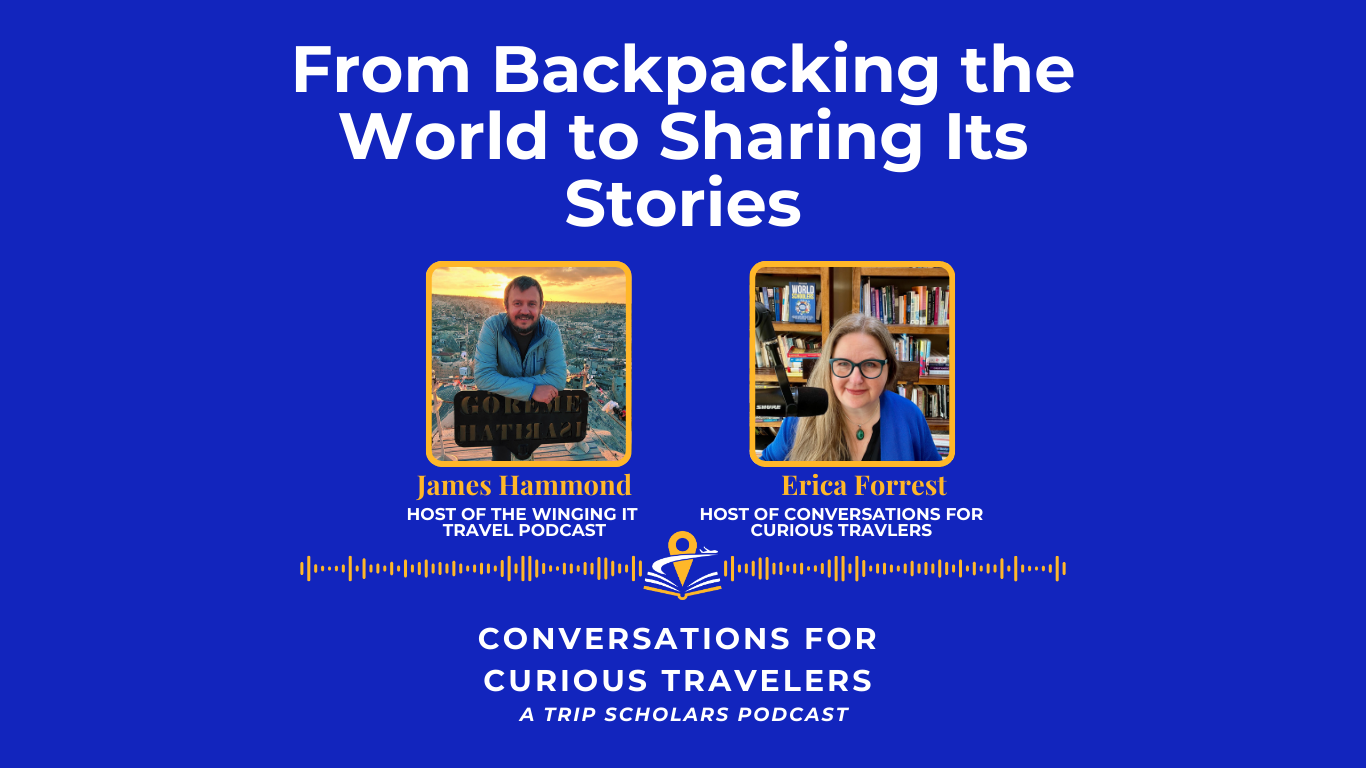
Show Notes: From Backpacking the World to Sharing Its Stories: James Hammond
Travel Storytelling · Cultural Connection · Backpacking
Travel is often inspired by a desire for adventure. But over time, it can become something deeper: a way to build connection, expand empathy, and better understand ourselves and others.
In this episode of Conversations for Curious Travelers, I’m joined by James Hammond, creator and host of the Winging It Travel Podcast, the Roaming with Hammo YouTube channel, and a member of the Voyascape Network. Drawing from his experiences traveling through 70+ countries, James reflects on how his journey has evolved — from adventure-driven travel toward a more connection-centered approach.
Together, we explore what it means to slow down, stay open, and travel without rigid expectations. James shares powerful stories from his time trekking in Nepal, moments of awe and humility, and how staying curious has helped him form meaningful connections across cultures. We also discuss storytelling, content creation, and why presence and flexibility often lead to the most memorable travel experiences.
This conversation offers inspiration, perspective, and practical ideas for anyone who wants to enhance their travels.
Episode Highlights
- Lessons learned from visiting over 70 countries
- The shift from adventure-based travel to traveling for connection
- A moving story from trekking in Nepal
- How curiosity and flexibility open the door to deeper cultural connection
- Tips for traveling more thoughtfully, including walking tours and overland travel
- What storytelling has taught James about reflection and presence
Next Step
Plan a weekend trip to a place a few hours from home that you have never visited before.
Reflection
James shared an inspiring quote by Mark Twain:
Twenty years from now you will be more disappointed by the things you didn’t do than by the ones you did.
Connect with James
Roaming With Hammo YouTube Channel
Resources Shared in the Show
Voyascape Network
Curious Tourism
The Mad Traveler
Life in Three Dimensions: How Curiosity, Exploration, and Experience Make a Fuller, Better Life by Shigehiro Oishi
Thanks for joining me on Conversations for Curious Travelers, a Trip Scholars podcast. I’m so glad you are here!
Please support the show— follow and leave a review—it helps more thoughtful travelers like you discover these conversations. Thank you!
Want to make your next trip even better?
Download your free guide: The Curious Traveler’s 5-Step Guide to More Meaningful Trips
Ready for personalized support?
Explore my workshops, classes, and travel coaching to get expert guidance in planning meaningful, personalized journeys at TripScholars.com
Let’s stay connected:
Follow me on Instagram, Facebook, and Pinterest
Subscribe to the Trip Scholars newsletter for travel insights, educational resources, and podcast updates.
Explore more episodes and free resources at TripScholars.com
Listen & Follow Here







Transcript: From Backpacking the World to Sharing Its Stories: James Hammond
[00:00:00]
[00:00:00] Erica: Welcome to Conversations for Curious Travelers, a Trip Scholars podcast. I’m your host, Erica Forrest. In each episode, we explore how travel helps us learn more about the world and ourselves. If you travel, not just to escape, but to grow, connect and understand you are in the right place.
[00:00:20] Erica | Trip Scholars: Today I am very happy to welcome James Hammond to the show. He is the creator and host of the Winging It Travel Podcast, a show that blends authentic storytelling with practical travel insights. He’s also the host of the Roaming with Ham O YouTube channel and part of the Voya Escape Network.
[00:00:39] James is a seasoned budget backpacker who has explored over 70 countries across our globe. He brings listeners into the heart of each journey through raw, immersive narratives and candid reflections. James, welcome to the show.
[00:00:55] James Hammond: Hi, Erica. It’s a pleasure to be here.
[00:00:58] Erica | Trip Scholars: I am so happy to have you here today, and I really appreciate all that you bring into this space, and I’m grateful to get to share some of your stories and insights with our listeners today. So thanks again.
[00:01:09] James Hammond: No, I love connecting with people from around the world, but also other podcasters. It’s a, it’s a unique little niche community we have.
[00:01:16] Erica | Trip Scholars: It is we’re very lucky to be part of it. And I would love to start today’s show by hearing kind of how you got started traveling and how that brought you to where you are today.
[00:01:26] James Hammond: Yeah, so childhood for me was no travel because coming from quite a poor background. the odd, summer we go for a week or two if we’re lucky to somewhere in uk, but not too far from when, from in Norwich. So that’s east of England. And then I got to. to London to go to music college. I managed to pass an audition, somehow. And then when I was there I got to see other cultures in London. because Norwich is very small and not very diverse, but London is the opposite. So I got to learn all these different things and meet different cultures and different people in my music college. And that was kind of the start of maybe learning other cultures,
[00:02:08] midway through my degree. I met this girl. From where I’m from and we had a little romance in the summer and she had just been traveling. So she went, she introduced this concept to me of like, oh yeah, I just went for three months. I was like, three months.
[00:02:21] How’d you go for three months? So she went to Southeast Asia New Zealand, a bit of Australia, Fiji, la and then back to uk. And that kind of like, made a mark. I probably didn’t realize you could do that. I didn’t think it’s possible. Maybe from that poor background, like how can you afford to go like that? And then I went to Australia later that year and I could not believe what I saw when I landed. And I think from then I was like, do you know what? I’m don’t know forget music. I’m don’t know finish my degree. I’m two years in at four.
[00:02:51] I finished my degree, but I think I’m don’t know go off on my travel. So in 2013, I went off on a two year trip and that
[00:02:58] Erica | Trip Scholars: Wow.
[00:02:58] James Hammond: work permit in [00:03:00] Australia, probably around 20 countries, Southeast Asia, south America, north America, a bit of Europe. And then that was kind of the start of the, of the journey really until today.
[00:03:10] So that’s how we got started. Yeah.
[00:03:12] Erica | Trip Scholars: That’s a wonderful story. So that really lit the spark for you. When she explained how she was able to travel for three months and then you, you were inspired and able to make it happen for yourself. Two years is a big one to start with.
[00:03:26] James Hammond: Yes.
[00:03:26] I.
[00:03:27] from Australia, when I came back it’s like exactly two years before I went, I was like, right, I need to get a job. I need to save money for the first time. I just used to earn and spend it like you do when you are young
[00:03:37] Erica | Trip Scholars: Yes.
[00:03:37] James Hammond: and I need to. Maybe get used to not doing things. It’s a bit of hard to explain.
[00:03:42] Like when you, when you are in music college, there’s always events going on. There’s gigs,
[00:03:45] Erica | Trip Scholars: Mm-hmm.
[00:03:47] James Hammond: And I was like, no, I’m not don’t know spend any money. So for two, so for two years, I literally bunkered down and worked.
[00:03:52] Erica | Trip Scholars: Uhhuh.
[00:03:53] James Hammond: I didn’t, I didn’t date anyone on purpose because I was like, no, I don’t want no distractions.
[00:03:56] Erica | Trip Scholars: Yeah.
[00:03:56] James Hammond: no dating,
[00:03:57] Erica | Trip Scholars: Yeah.
[00:03:58] James Hammond: Music to get by and nothing else and just work and save money. So I managed to save just enough to go for two years.
[00:04:04] And that money did run out after six months, and then I, then I was working in Australia and got a job and
[00:04:09] Erica | Trip Scholars: and you found a way to make it work so you could stay longer. And then how did, how did that experience as a young person lead into what you’re doing now where you’ve really been able to make travel your career or a career outta travel?
[00:04:23] James Hammond: Yeah. I mean, yeah, it’s true. But I wouldn’t, I wouldn’t say for first 10 years of that it did match. I was in the cycle of. Work, money, quit job, go and travel for how long? I can do
[00:04:38] Erica | Trip Scholars: Yeah.
[00:04:38] James Hammond: maybe, maybe a year, and find a job and redo a cycle, right? So that was like for 10 years. And then when I got back, when we got back from my year trip in 2023, at the start of that year, I thought, do you know what?
[00:04:51] I’m don’t know do the podcast on the road. I’m don’t know make a living and it’s don’t know be like a free lance thing. From then on did not turn out to be the case, the opposite. I had no money. So I got back in January, 2024. Yeah, last year like, right. So for the next couple years I need to go business mind to try and make this thing a long term thing.
[00:05:14] So what I mean by that is you can go and travel as much as you want, but if you can’t earn your own money and you’re not location independent, it’s always don’t know be save up, go for a long time, get a new job, and these jobs become. Things you’re not interested in. I think the switch happened last year, I think when I came back and said, okay, I love travel.
[00:05:33] It is don’t know come in the future, but I’m willing to wait it out to get the business side going. So that’s where we started.
[00:05:39] Erica | Trip Scholars: Well, good for you. It’s a lot of work.
[00:05:41] James Hammond: the podcast.
[00:05:42] Erica | Trip Scholars: Yeah. Yeah, it’s a lot of work, but it’s really inspiring to see how much you’ve been able to grow it you really have a lot of inspiring travel stories to share and you bring on some great guests.
[00:05:53] I was wondering if you could maybe start with a story about one time you had a travel experience [00:06:00] that really did help you, learn more about yourself or our world.

[00:06:03] James Hammond: Yeah, that’s a great question. And I had to prepare for this one because there’s, there’s many times, right? I think for me. What was quite an inspiring moment was I was hiking the Langtang Valley in Nepal, and when you hike in Nepal amongst the Himalayas, you kind of do realize that you are pretty small. I mean, these mountains are huge. And you’re walking in this valley in between, right? And it’s like, Like I either side is incredible, but you get a stark reminder as you go through you, you hike from Syabru Besi which is like a small town and you hike the Langtang Valley Trek and the endpoint is Kyanjin Gompa, which is like the last village. before that it was Langtang Village. And I don’t know if you, if you recall many years ago there was an earthquake in Nepal, pretty devastating one.
[00:06:50] Erica | Trip Scholars: Yeah.
[00:06:51] James Hammond: And the Langtang Village got decimated. Buy this avalanche. So when you come to the new Langtang Village, before that, it’s this rubble and there was the old Langtang village.
[00:07:02] Erica | Trip Scholars: Wow.
[00:07:02] James Hammond: I think when I got there with my guide, I stood there and I was like, God, do you know what? Nature is pretty powerful. And it’s like, you have, you have no control of this.
[00:07:10] Erica | Trip Scholars: Mm-hmm.
[00:07:10] James Hammond: And I was like standing there thinking, I don’t even want to walk rubble. because I feel. But it’s kind of disrespectful. But you know, he, he kind of said, no, don’t worry about it.
[00:07:18] Like, we’ll, we’ll pay our respects. We’ll go across carefully. There’s a, there’s like a path to go through and we’ll get to the village and we’ll stay a night. And then next morning I went to the local, believe it or not, there’s a cafe there that sells espresso coffee in Langtang Village. You have to carry it with the espresso machine all the way up the mountain. I met the guy who owns it Mipang his name is, and I sat there and I said, oh. Can I ask you questions about that period? And as I was talking to him, his 103-year-old aunt walked in
[00:07:46] Erica | Trip Scholars: Wow.
[00:07:46] James Hammond: she survived the avalanche. And I was like, I got to ask, how does she survive this? And he said, oh, she got scared and she hid under a desk that part of the house was the most I guess the strongest part of the house.
[00:07:57] Right? So she survived because it went over the house and decimated around her
[00:08:00] Erica | Trip Scholars: Wow.
[00:08:01] James Hammond: survived it. And he was saying, yeah, we, we lost some family like his, some of his parents brothers and stuff like that. And just hearing those stories just humbled me a little bit and I was like, do you know what we need to kind of we want to do in life and don’t take anything for granted, like being here or thinking it’ll come later in life.
[00:08:18] So the human story, but also seeing the nature in like a day or so was quite a humbling experience. I think that has influenced me quite a lot.
[00:08:26] Erica | Trip Scholars: I do agree with you that one of the best gifts travel gives us is that sense of awe and humility and just how precious it is to be alive right now and not to waste it. So thank you. That’s a powerful story.
[00:08:44] James Hammond: Yeah. And when I got, just to finish on that story, when I got to the top, Ken Jpa, you see the Himalayan Mountains in the morning for sunrise via your coffee. And it’s like snow capped mountains, like 360 degree views and these ones are like above 7,000 meters. They’re huge. And you think, wow, this is like [00:09:00] unlike anywhere else in the world.
[00:09:01] It’s, it’s pretty insane. So if you listen and you want to do a nice five day hike up some altitude, it’s a great one to do.
[00:09:07] Erica | Trip Scholars: So it sounds like just like the elevation changes you had psychological changes that were kind of a rollercoaster, sublime and also all that connection and humility and everything wrapped up into one.
[00:09:20] James Hammond: yeah,
[00:09:20] Erica | Trip Scholars: for sharing that story, James. I,
[00:09:22] James Hammond: worries.
[00:09:23] Erica | Trip Scholars: appreciate it.
[00:09:24] Yeah. I bet that both through your travels and then also as a podcaster, you have met so many remarkable people over the years. It sounds like he’s one of them and his aunt.
[00:09:36] James Hammond: Yes, absolutely. And early doors. I think when I started the podcast, it’s COVID and we couldn’t travel, right? So what’s the thing you’re don’t know do? You’re don’t know talk about it with people you’ve met. So that was kind of the ethos for the first two years of
[00:09:47] Erica | Trip Scholars: Yeah.
[00:09:47] James Hammond: really.
[00:09:48] Erica | Trip Scholars: Yeah. And almost everybody does have a travel story, at least one or two that they love to share.
[00:09:53] you are able to make travel itself into your profession here as a podcaster. What’s it like making a weekly show while you’re on the move? I know you’ve done it both with a home based and while you’ve been traveling.
[00:10:08] James Hammond: Yeah, I’ve learned a lot on this. Yeah. Okay. So some lessons I’ve learned when you are traveling you’re trying to record or interview online, there’s a few snags. First of all, what I’ve learned is that wifi is never guaranteed. Even hotspotting, you think, oh, I’ve got 5G. It’s not guaranteed. So getting wifi for a good connection for an interview was, was stressful.
[00:10:32] And I’m finding a quiet space. I mean, I’m lucky here in Vancouver we have a, some libraries that have a podcast studio that can rent for free.
[00:10:41] Erica | Trip Scholars: Oh, how nice.
[00:10:42] James Hammond: yeah, so it’s great. It’s a great resource. But when you’re traveling abroad in all these different countries, there’s no guarantee of that at all.
[00:10:48] Erica | Trip Scholars: Yeah.
[00:10:49] James Hammond: So for El Salvador, for example, I managed to find a recording studio in San Salvador in their brand new library in the middle of Square in the
[00:10:58] Erica | Trip Scholars: Ah,
[00:10:58] James Hammond: and interview a local tour guide.
[00:11:00] So
[00:11:01] Erica | Trip Scholars: yeah.
[00:11:01] James Hammond: win, right? We’ve got, I’ve got a local come onto the podcast. It’s in a little recording studio it was just a great setup. But don’t, don’t think you’re don’t know get that everywhere. Everywhere you go is, is don’t know be different types of setups, so,
[00:11:14] Erica | Trip Scholars: That’s fantastic advice. Yeah. I
[00:11:16] I think for many. Any kind of work that people are doing while they’re traveling, finding that cadence of enjoying where you’re at or appreciating where you’re at, and then also being able to focus enough on, on your work. How do you, how do you balance that out?
[00:11:33] James Hammond: Yeah, it’s great question. There’s more of a thing for YouTube as well, because might be rerecord, you might be recording the same thing you did yesterday. So what I do is if I’m in a new city, for example, I have the first day exploring
[00:11:44] Erica | Trip Scholars: Mm-hmm.
[00:11:45] James Hammond: to talk about something I don’t know for a start.
[00:11:48] And also, I don’t want to be, I guess like pre presuming what I think is don’t know be there in this place I’m seeing, right? So I
[00:11:55] Erica | Trip Scholars: Yeah.
[00:11:55] James Hammond: day exploring at least first. And then I bake in hours [00:12:00] going forward to do the recording. So for a podcast, like if it’s an interview, you probably don’t know have to like coordinate a few days in advance.
[00:12:08] So I try to stick to like a bigger city for three days at least, and try and get maybe a morning for me in the studio to do an interview.
[00:12:16] Erica | Trip Scholars: Mm-hmm.
[00:12:16] James Hammond: With a good wifi connection, hopefully, but also do my solo episodes. So I on purposely have of times throughout the day to record my podcast and for YouTube, explore first and then re-explore and record that.
[00:12:31] Erica | Trip Scholars: Ah, very good. Very good.
[00:12:34] James Hammond: I don’t, I don’t often record on the fly. First thing I’m seeing it, but I do for the podcast because I do the sound immersive stuff. So I try and get a little bit of reaction if I’m seeing something for the first time
[00:12:45] Erica | Trip Scholars: Yeah.
[00:12:45] James Hammond: to collect that sound. Right. So I
[00:12:46] Erica | Trip Scholars: Yeah.
[00:12:47] James Hammond: for the podcast.
[00:12:48] Erica | Trip Scholars: Yeah, that’s super helpful. Thank you. Yeah. Question I am asked somewhat frequently is about how do you kind of stay present when you are, when you’re traveling, when you’re still documenting things. And that is similar to the advice that I give people. You know, like if you’re in a museum or if you are at a cultural site, just be present to it.
[00:13:11] And then choose to go back later. Just like you were saying, the first day that you’re somewhere, you’re not recording, be present, appreciate what you’re appreciating, and then at the end of your time at a site, go back and take the photos or you know, if it’s a really big site when you’re leaving a particular area so that you but that we’re not so distracted by, by our phones and documenting everything.
[00:13:33] So thank you.
[00:13:35] James Hammond: That’s okay. Yeah, it’s a tough one because I like for, for sites that are a bit smaller, like, for an example, last year in El Salvador went to Tazumal which is like a Myan ruin. You’re not don’t know go back to that. So what I did was I did a loop. Being present, seeing the sites got back to the start. Then recorded the loop
[00:13:51] Erica | Trip Scholars: Yeah.
[00:13:52] James Hammond: but recording.
[00:13:52] So that’s the an an example people need.
[00:13:55] Erica | Trip Scholars: Yeah, that’s perfect. And you do so much education and you have traveled so extensively. Some of your listeners or people who are watching your YouTube channel aren’t necessarily going to get to go and visit those places for themselves, although you’re giving great advice. So hopefully they can. But then.
[00:14:10] They are able to be learning. So there’s such value in capturing it, just finding a way to do do it in both ways, so that’s great. Yeah. I actually was recently enjoying your recent episode where you were going back to your very first episode of your show and kind of reflecting on how. How things have changed for you or how you’re seeing things differently and which things moved forward in the way that you had imagined.
[00:14:40] Could you share with us a little bit about one of the things that came up for you in that episode?
[00:14:46] James Hammond: Yeah, that’s an interesting one, isn’t it?
[00:14:48] Erica | Trip Scholars: Yeah, yeah. I really appreciated everything that you shared, that you learned about yourself.
[00:14:53] James Hammond: Yeah. I’ll tell you what has been the biggest change since then. So that was pre co that was in COVID pre my one year [00:15:00] trip.
[00:15:00] Erica | Trip Scholars: Right. So that was nine. That was 2021.
[00:15:03] James Hammond: yep.
[00:15:04] Erica | Trip Scholars: Okay.
[00:15:04] James Hammond: we went for a year trip in 2023.
[00:15:07] Erica | Trip Scholars: Hmm.
[00:15:08] James Hammond: I don’t want to use like this corporate buzzword, it’s like, it’s mindset is, is what I’m don’t know use as the word mindset. That mindset In 2021, February, when I first recorded it was still the old mindset. Of here in Canada for two years because we had a work permit and when we finish two years, I’m don’t know go off for my travels for a year and then who knows what happens after that. But because of COVID, we actually ended up staying in, because we can get permanent residency and now we’re citizens.
[00:15:34] Erica | Trip Scholars: Ah, congratulations.
[00:15:36] James Hammond: yeah.
[00:15:36] Thanks. Yeah, it’s
[00:15:37] Erica | Trip Scholars: That’s a journey
[00:15:39] James Hammond: Yeah. Yeah. A long journey and I’m glad we’ve done it. Yeah. because it’s, it’s worth it. But for the old mindset. That was just
[00:15:45] I.
[00:15:46] and going traveling. But this new mindset, what I’ve learned reflecting back on the episode was, know what? going into late thirties now and I would like a home base. I never thought I’d say that. But I’d like a home base for a couple of reasons. One is to record and do content creation like we do,
[00:16:02] Erica | Trip Scholars: Mm-hmm.
[00:16:02] James Hammond: two, if you just want to stop for month or two or three months or just like chill out. Where are you don’t know go if you have to find somewhere to rent or Airbnb all the time.
[00:16:11] I think that gets tiresome after a while and I’m, I’m done with it. So I’m
[00:16:14] Erica | Trip Scholars: Yeah.

[00:16:15] James Hammond: in this new phase, I need a home base. And I think long term, that enables me and us to travel more because we have somewhere where we can go back to. And it’s not always a stress about when you finish a trip to figure out what you’re don’t know do.
[00:16:29] Erica | Trip Scholars: Right.
[00:16:29] James Hammond: think I’ve changed my mindset in terms of how I travel, where I’m not as fast anymore. I want to do slower travel, but to do that. I need a home base. So when I heard that back in 2021, I was like, oh yeah, that’s, that’s a big change. Probably the biggest change I think
[00:16:43] Erica | Trip Scholars: I love that you and your partner are open to changing and adapting as you move through life and reflecting on what do you really want now?do you think that through all of your travel experiences being open. I mean, you are very open to new experiences. That, that helps you have a mindset where you can kind of challenge your previous beliefs or thoughts about how you wanted to live your life,
[00:17:11] James Hammond: Yeah, I think the last three years I’ve been really invested in. open myself up to local people. So when I do now travel since 2023, I’ve really got into finding local people on the ground to interview for the podcast.
[00:17:25] Erica | Trip Scholars: Hmm.
[00:17:25] James Hammond: like hearing their story and learning about the place I’m in because I don’t think you get a proper understanding unless you coordinate with a local to hear about their side.
[00:17:34] Erica | Trip Scholars: Yeah.
[00:17:35] James Hammond: that sticks out for me is El Salvador. I mean, it’s in the news, right? We, we all know that country is, could be controversial for some people. And maybe unsafe. So I went there with a real open mind, I’m don’t know backpack this for two weeks solo. I don’t know what, I don’t know what to expect. I don’t know what people can be like.
[00:17:51] Is it don’t know be safe? I have no idea. So I went there with a complete open mind and the first thing I did in the first two days is speak to two free walking tour [00:18:00] guides to get a feel for the place. And that was invaluable. And as I started to go through the country, I started to realize, wow, people here are absolutely amazing and it’s the most popular. YouTube series I’ve done, right? Because people from El Salvador love seeing you go and check out their country because maybe they’ve not been back for
[00:18:16] Erica | Trip Scholars: Yeah.
[00:18:17] James Hammond: years because of the, and the Civil War and stuff, right? So that was a real eye opener I think I’m really open to that sort of experience because I’m really invested in culture and local people I think is quite key in this day and age that we have to learn. What people are about locally in different countries and different cultures, because I think there’s a lot of views out there, which are not very nice and not very true. And I think it dominates a lot of people’s lives from the, from the TV screen or from social media, right. So I think my message is basically I want to get out there, speak to people, and share that message with people who might stumble across the podcast or the YouTube.
[00:18:54] Erica | Trip Scholars: And I know that as you’re sharing those stories, you’re really breaking down stereotypes and, preconceived ideas because for so many of us, our ideas are all coming from media before we arrive somewhere. And you’re able to really. Challenge a lot of those and hopefully open up hearts so that we are able to build these bridges in the world.
[00:19:17] Yeah.
[00:19:17] James Hammond: you, I’ll tell you a really quick example of what I saw in El Salvador. I joined. A huge group from G Adventures. I don’t know if you know G
[00:19:24] Erica | Trip Scholars: Yeah.
[00:19:25] James Hammond: like a tour group. mainly for 18 to 30 year olds. Let’s go with that, that age bracket. But I booked through WhatsApp. I booked the Civil War, right?
[00:19:33] I’m don’t know speak to a Civil War veteran. We’re don’t know climb up to the hills and go and check out the hideouts, see a waterfall. like, oh, that sounds great. Met the guy who owns it called Daniel in Toto. He owns a company there. Eco Tours. And he’s like, oh, you’re joining the group today. I said, okay.
[00:19:48] He goes from Geo Ventures. I’m like, oh, that’s don’t know be interesting. The first thing we did once we kind of drove to the area is we got to speak to Nelson, the the Civil War talk guy. Right. And I had like a hundred questions and I was like, prepping him in Spanish. Right. My bad Spanish. I was like, I want to know this, this, and this and this. So I was engrossed by just hearing this guy speak about the nineties, going into the two thousands with Civil war and gangs and stuff. I did observe around me that. And this is nothing against them, and this would’ve been me 10 years ago. They’re just not that interested. They’re just kind of zoning out.
[00:20:19] They’re probably hungover. a thing that’s on their tour, but they got me and maybe a few other guys a bit older, like just keeping a hand up for questions. They’re probably get annoyed up, get asking questions, right. And I think that’s the, that’s the journey I think, when you’re younger. And so be it.
[00:20:33] You’re don’t know be more. Interest in hedonistic stuff, I’d imagine. But when you go into later thirties and forties and you’re still traveling, as you’re putting more interest in the people and the culture and the food and getting to know the place a bit more, so that, that was a good dynamic there that I saw.
[00:20:47] I was like, oh yeah, that was me 10 years ago. This is me now.
[00:20:50] Erica | Trip Scholars: Mm-hmm.
[00:20:50] James Hammond: But I don’t judge ’em for it. It’s just the journey you go on.
[00:20:52] Erica | Trip Scholars: Yeah. Yeah. And everybody’s journey is so different. I’m actually reading a book right now called life in [00:21:00] Three Dimensions, and it is talking about, this concept of living a good life and that so often it’s kind of this hedonistic version, what you were just talking about, all the pleasure.
[00:21:12] And that that is one of the things that drives so many of us to travel. I just want to lay on the beach and drink mai tais or something.
[00:21:19] James Hammond: Sure.
[00:21:19] Erica | Trip Scholars: And then there is this other concept that. People talk about meaning and like giving back and living from a place of gratitude. And then there’s this third one that is more about learning and growing, challenging ourselves, doing things that might be uncomfortable.
[00:21:38] Kind of the opposite of that hedonistic part. But. But being driven by this curiosity and desire for new experiences or being open to new experiences, and so for you to talk about, you know, your personal journey from one to the other, I just love that. Thank you. That’s great.
[00:21:56] James Hammond: Yeah,
[00:21:57] Erica | Trip Scholars: Yeah.
[00:21:57] James Hammond: worries.
[00:21:58] Erica | Trip Scholars: And we will be linking to both your podcast and your YouTube channel so people can come and check out these stories for themselves where you get into them even more deeply.
[00:22:07] if you could go back to yourself as a younger person, would you give advice to yourself or do you think you might not have been quite ready to take some of that advice?
[00:22:18] James Hammond: Hmm. I would give advice, but not on the part.
[00:22:23] Erica | Trip Scholars: Okay.
[00:22:24] James Hammond: I would let myself learn those lessons. the advice I’d give is, James just document it
[00:22:29] YouTube podcast was, was going then even YouTube, the big YouTubers, I’m not saying they’re not great, but the big YouTubers who got like millions of followers, they all started in 20 12, 20 13, the heyday,
[00:22:40] Erica | Trip Scholars: mm-hmm.
[00:22:40] James Hammond: and they just ridden that wave and kept going.
[00:22:42] Erica | Trip Scholars: And think I tell my 21, 22 yourself. You know, be proficient on a laptop, learn some video and audio editing and record your travels.
[00:22:51] It would’ve been a lot harder back then, but that, that is,
[00:22:54] James Hammond: Yeah. Yeah, yeah, yeah.
[00:22:55] Erica | Trip Scholars: that is such good advice. I think one of the sadder things about travel, but also amazing things about it, is that it is so fleeting and that, if we’re not intentional. About documenting it or finding a way to kind of carry those lessons that we’re learning and experiences and connections that we’re making.
[00:23:16] If we don’t find a way to bring that with us when we come home. Then they kind of peter out, you know, they kind of fade away. So, um, you have been documenting a lot now and, some of the people that you traveled with at the time, you’re bringing some of those folks back onto the show because just what you were talking about, it wasn’t all documented and by reliving the stories, you’re able to.
[00:23:41] Capture more of what you guys experienced. Love that.
[00:23:45] James Hammond: because I. Unbelievably, I didn’t take a camera when I was, went to Southeast Asia in 2013, or New Zealand or
[00:23:51] Erica | Trip Scholars: You were living in the moment.
[00:23:52] James Hammond: Yeah. Literally living in moments. So all my memories are memories from that. There’s no, there’s a few photos found about on social media, but [00:24:00] those days it, it really was like, you would probably jump on a PC or a, not a laptop, but yeah, be PC in a hostel if you’re lucky.
[00:24:07] Erica | Trip Scholars: Right for your allotted? A short amount of time. Not for the whole day. Yeah.
[00:24:12] James Hammond: And you book things by going somewhere and asking someone Can I book a bus to Cambodia? Yeah. Okay. Like it was that, it was that raw,
[00:24:18] Erica | Trip Scholars: So different.
[00:24:19] James Hammond: Maps. No, I had no smartphone. I had no phone. No camera.
[00:24:23] Erica | Trip Scholars: Yeah.
[00:24:23] James Hammond: I
[00:24:23] Erica | Trip Scholars: I.
[00:24:24] James Hammond: for that six months probably living day to day, moment to moment.
[00:24:28] And no thought of like really posting on social media. because I didn’t really have the means to
[00:24:33] Erica | Trip Scholars: Yeah.
[00:24:34] James Hammond: the odd update on Facebook. But that was it. Yeah.
[00:24:36] Erica | Trip Scholars: So in some ways living in a more liberated way, traveling in a more liberated way because you, you were just experiencing and connecting. Yeah.
[00:24:45] James Hammond: Met so many great people on that trip. Yeah,
[00:24:47] Erica | Trip Scholars: Yeah. Well, there’s wisdom in there for those of us traveling now with the whole world in our pocket.
[00:24:52] James Hammond: yeah, I think smartphones are an interesting conversation, aren’t they? Yeah.
[00:24:55] Erica | Trip Scholars: They really are.
[00:24:55] James Hammond: to go off, I tried to go offline. I don’t. I don’t try to buy an e sim anymore. I try to rely on wifi. So throughout the day, I’m not just scrolling my phone. It’s like, no, I am here to live in the moment. So that’s my little trick for
[00:25:08] Erica | Trip Scholars: a great tip. Yeah, that’s a really great tip. Yeah. I’m sure you have a lot of great advice for our listeners. Do you have any suggestions?
[00:25:18] James Hammond: Yeah, so I love free walking tours. I don’t know if people do free walking tours.
[00:25:22] Erica | Trip Scholars: Yeah.
[00:25:22] James Hammond: every city would have these. And the bonus of this is there’s a two-pronged attack here. You’re don’t know get a local, doing your tour who probably speaks English because you can choose a language. And secondly, you’ve probably been a group of like, I don’t know, between two to six people, maybe 10 if you’re lucky. So not only are you don’t know get to know a local and you could probably ask ’em to go for a coffee afterwards and they’d be happy to do that. You also might meet some potential new travel friends in, in there, right? So previously I’ve done tours where the tour finishes at like, I don’t know, 4:00 PM I was like, oh, should we all go?
[00:25:53] Should we all go for dinner somewhere? I was like, yeah, yeah, we’ll go for dinner. So you instantly making connections. Which seemed quite seamless and it’s not too forced, and that’s a great way of meeting people and you learn about other travelers and what they’ve seen in that country or their travels and learn about their lives, and also you learn from a local about the place you’d just seen. Right. So I, love connecting with like the local tour guys. I love asking to go on the podcast so I can record them as well.
[00:26:18] Erica | Trip Scholars: That’s
[00:26:19] James Hammond: so yeah,
[00:26:19] Erica | Trip Scholars: tip.
[00:26:19] James Hammond: kind of recommend that if you’re looking to meet people as well as sociable hostels or, or hotels, which I’ve done previously as well.
[00:26:27] Hotels can be difficult because it’s kinda a bit more siloed. But that’s the best tip to meet people I think is free walk and tour and the people on it. And that would definitely
[00:26:35] Erica | Trip Scholars: Good. That’s really great and can you just clarify for anyone who hasn’t gone on one, even though they are billed is free, it’s customary to usually tip the guide because they’re often not paid.
[00:26:48] James Hammond: Yeah, that is number one rule. So you can book these on, I don’t know, TripAdvisor or, or Guru Walk. I use guru walk for mine. They’re free in in quotation marks because there’s no payment for it. But when you [00:27:00] finish the tour, you definitely should tip 10, 20, $30.

[00:27:03] Erica | Trip Scholars: Wonderful. Thank you. And I know you’ve got a few other suggestions
[00:27:09] James Hammond: Yes. I think you need to be honest with yourself about what your favorite types of travel is.
[00:27:13] Erica | Trip Scholars: Mm-hmm.
[00:27:13] James Hammond: by that is are you backpacking just for the sake of it, you don’t really like it that much, or is another type of travel. So I’ve learned in my travel is that. love backpacking. It’s probably, but it’s number three.
[00:27:24] I love backpacking. It’s kind of like maybe the first love if you like. But I’ve learned since then, I prefer other ways of traveling. And these two for me personally are train travel. I love going on trains
[00:27:35] Erica | Trip Scholars: Yeah.
[00:27:36] James Hammond: and I love road trips. So these
[00:27:38] Erica | Trip Scholars: Ah.
[00:27:38] James Hammond: preferred ways of traveling. I’ve done a lot of road trips in different countries. Canada was eight weeks. USA was six weeks. West to east, east to west and Europe and Middle East. We’ve, we’ve done some road trips and I think for me, I’ve learned that if we can do a road trip or a train travel trip, in my element. I love it. I love going to the platform on a train station, getting your seat, sitting on a train, watching the world go by as you take two or three hours to go.
[00:28:02] Right? So I’m a big fan of this type of travel and I think for listeners, have some questions to yourself, like, what would I like to experience that I think I would like
[00:28:11] Erica | Trip Scholars: Yeah.
[00:28:12] James Hammond: base it on that type of travel, not just because you think you should go somewhere. I have a, an idea of a place in mind, but if you’re don’t know, if you, if you’ve got American listeners and they’ve never been to Europe, you know, go and land somewhere like Switzerland. get your train. It’s don’t know be on time and you have so many options to go anywhere you want. You got, you got whole Europe to aim, aim towards, right? So. know, I love the the train in Switzerland over the Alps. It’s called the Benina Express, and it goes from Cher or Ker in Switzerland to Toronto and Italy. And we did that for my partner’s birthday in 2023. And you can
[00:28:47] Erica | Trip Scholars: Spectacular.
[00:28:49] James Hammond: and you go from like. warm weather up into the, like the ski fields are and stuff,
[00:28:54] Erica | Trip Scholars: Yeah.
[00:28:55] James Hammond: up and then down and the views are incredible. You’ve got a panoramic view in the train. So that’s kind of the stuff I like, but I’ve learn this as I’ve, as I’ve gone on. And also to add to this. My one big tip by saying my podcast is if you’re don’t know go into an area, Southeast Asia, for example, do it over land, don’t fly,
[00:29:14] Some land, do some land borders, and get buses and, and mix of people that way.
[00:29:18] You, you’d certainly learn a lot about yourself and the customs of local people as you go across these borders you’re not flying, which is always a good thing. So of overland travel is great if you can
[00:29:29] Erica | Trip Scholars: You can learn a lot trying to learn how to navigate a bus or a train system in another country, especially if you don’t speak the language. It can be a, a very humbling and exhilarating experience, but you will remember them.
[00:29:43] James Hammond: absolutely. And you’ve learn something about yourself, right? Let’s say you don’t like it, at least you’ve learn yourself something, right? You can take back with you and change from the next travels, right?
[00:29:52] Erica | Trip Scholars: Yeah.
[00:29:52] James Hammond: a win-win.
[00:29:53] Erica | Trip Scholars: Yeah, that’s, that’s great advice. Thank you. I just to tag onto that, keep an eye on what the locals are doing to [00:30:00] exit because it can be tricky to get off of a different kind of bus or tram into different countries.
[00:30:06] James Hammond: Yes. And also I, yeah, I got stuck at the Thailand and Lao border in Southeast Asia.
[00:30:12] That crosses I got held at the board of 30 minutes by these Army guys at gunpoint. Not a great experience really, but I learned a lot. Wasn’t, fault on my part. I don’t think, I just didn’t have the, stamp into the country.
[00:30:24] I had the visa, but not the stamp. So at the other border
[00:30:27] Erica | Trip Scholars: yeah, I.
[00:30:27] James Hammond: from Vietnam, I obviously missed a sign and didn’t follow the people, wasn’t paying attention and unawares, I probably just walked straight onto the bus and that was fine as in the country, but leaving was a hassle. So I had to, I basically got bribed some money.
[00:30:40] I tried to negotiate, negotiate my way out of it. I tried to go to Thailand and they sent me back across the border. So these are things I learned.
[00:30:47] Erica | Trip Scholars: Learn the hard way.
[00:30:48] James Hammond: okay. The hard
[00:30:49] Erica | Trip Scholars: Yeah.
[00:30:49] James Hammond: So make sure you read the signs, follow the people and don’t doze off when you’re crossing borders because you can miss something.
[00:30:54] Erica | Trip Scholars: Thank you. Yeah, those are all really great tips. And then you have taken road trips not only throughout the United States and Canada. but also in the Middle East. What was that like?
[00:31:07] James Hammond: Yeah, we did road trips in Jordan and Oman. Two very different experiences.
[00:31:12] Erica | Trip Scholars: Yeah.
[00:31:13] James Hammond: Oman, we went with this crazy idea to try and wild camp or boondock, I guess,
[00:31:18] Erica | Trip Scholars: Okay.
[00:31:18] James Hammond: might use. There’s no rules. You can camp anywhere in Oman, but there’s no facilities. And we started to realize this in quite hot weather that I don’t think this is durable.
[00:31:27] So for a week we tried to like just camp in, spots around the country and we just got too hot,
[00:31:32] Erica | Trip Scholars: Yeah. Yeah. It can be hard to just even sleep. Yeah.
[00:31:36] James Hammond: yet.
[00:31:37] Erica | Trip Scholars: Yeah.
[00:31:38] James Hammond: So that was a interesting trip. But the, the gas is cheap. It’s the cheapest. You’re don’t know find it like 20
[00:31:42] Erica | Trip Scholars: Wow.
[00:31:43] James Hammond: for the tank and
[00:31:44] Erica | Trip Scholars: Wow.
[00:31:45] James Hammond: Yeah, yeah, of course.
[00:31:46] Yeah. It’s super cheap and the roads are great, the brand new roads. So mine was. A great experience from the driving perspective, but maybe the camping was a bit ambitious,
[00:31:55] Erica | Trip Scholars: Okay.
[00:31:56] James Hammond: but Jordan was the opposite. So not great roads
[00:32:00] Erica | Trip Scholars: Mm-hmm.
[00:32:00] James Hammond: okay, amazing things to see everywhere you go. Two weeks were like, went to the hills and the mountains went to the Dead Sea.
[00:32:09] Erica | Trip Scholars: Wow.
[00:32:10] James Hammond: Petra, of course, and you can drive around really safely and. It’s pretty chill. Like it’s, it’s just like driving anywhere else and no problems whatsoever, and people are really nice to help you out. So the
[00:32:21] Erica | Trip Scholars: Wonderful.
[00:32:22] James Hammond: is a great place to road trip. I, I will stand by that. Yeah.
[00:32:25] Erica | Trip Scholars: One of the things that stands out for me sometimes when we are road tripping internationally is how much better the roads are in many other places. We’re currently living in Seattle, Washington, and our roads are notoriously. Hummocky and lots of potholes and we have traveled in other countries where they obviously are putting tax money back into the infrastructure.
[00:32:49] It it, and I think that’s one of my favorite things about travel is, you know, we’re kind of in our own bubble. In the world that we grow up in and what [00:33:00] we think of as normal And then when you travel, you get to see how other places might be doing things a lot better than what we’re doing here at home.
[00:33:08] And the quality of roads often jumps out at me when we’re traveling.
[00:33:13] James Hammond: Absolutely. The rose is an interesting one. I, the biggest shock I had in terms of transport. And you might find this if you go to Japan for example, or China, the bullet train system there is absolutely incredible.
[00:33:24] Erica | Trip Scholars: Hmm.
[00:33:25] James Hammond: Like when you sit on that bullet train and you’re going like four to 500 kilometers an hour and you don’t, you don’t hear a noise. Oh my God. And it’s all on time. It’s just incredible.
[00:33:36] Yeah.
[00:33:37] Erica | Trip Scholars: I also, appreciate that you really build a lot of space for spontaneity into your travels. Could you talk a little bit about that?
[00:33:47] James Hammond: Yep. I don’t plan too much.
[00:33:49] Erica | Trip Scholars: Yeah.
[00:33:50] James Hammond: For example, if I was going in and out of an area month, let’s say, let’s say Japan, because we did that for a month. We knew we’re in and outta Tokyo,
[00:33:58] Erica | Trip Scholars: Mm-hmm.
[00:33:59] James Hammond: but we had a month in between. we had a week in Tokyo and we’re like, do you know what? We’re don’t know get the Japanese rail pass and we’re don’t know. Just decide on a day where to go. because you can book in advance if you want to, but a lot of the time you can book like the non-busy times. You can just go the shin cans and the, the train system. I like to kind of wing it a little bit, hence the podcast name and not plan too much. So yeah, I. Make sure if I like somewhere I can stay and if I don’t like somewhere I can leave.
[00:34:27] Erica | Trip Scholars: Yeah.
[00:34:27] James Hammond: the idea behind it. And anything like meeting groups of people, like in Southeast Asian 2013, we met some people in Bangkok in our first week and we traveled with them. For six weeks. So we’re kind of like following each other’s schedule. Like we didn’t really have a plan, but we adapted to each other, right.
[00:34:42] And, together for six weeks. So that’s pretty cool. So stuff like that, I like to make sure I can have the option I just book a flight in and out. If you’re pretty dead set on a time to leave, so. Spontaneity for me is, is absolutely key to my trips because wouldn’t like to plan everything to a T because that could go wrong in a lot of countries.
[00:35:02] That could be, things could be canceled. Like you need to be a bit more flexible with certain countries. So spontaneity is, is number one for me.
[00:35:10] Erica | Trip Scholars: I love it. Yeah. When I’m working with different people, a lot of people have a much more limited time for their travels. But I, I counsel people try not to book even, you know, more than two big things in a day because Sometimes the very best memories come from meeting someone in a pub and then who knows what happens from that.
[00:35:29] Or like you were talking about if you’re on a, on a walking tour together. You want to make sure you don’t have to rush off to the next thing. And you really have space for serendipity to work. Its magic.
[00:35:42] James Hammond: And being present as well. Like you can be present because you want to be present
[00:35:45] Erica | Trip Scholars: Yeah.
[00:35:46] James Hammond: of it. So if something happens like that, like, oh wow, yeah, I’ll, I’ll stay an extra night and we’ll do a tour tomorrow, or whatever. Right. That’s great. That’s what travel is all about.
[00:35:54] Erica | Trip Scholars: Yeah. That’s wonderful. you have given us so many different, inspirational [00:36:00] stories and a lot of really great advice. Thank you. I appreciate it.
[00:36:03] James Hammond: Yeah, no worries.
[00:36:04] Erica | Trip Scholars: for listeners who are interested in traveling a little bit more like this for themselves, can you share with us one step people could take this week to start moving forward in that way
[00:36:17] James Hammond: Yeah, that’s a great question. There’s two answers to that for me. It’s like locally or internationally. I think, I think locally, if you are in the US and you are in Washington state what I would be doing. on our road trip is you’re probably used to the western side, you know, Olympic National Park and, all those like little islands on the left.
[00:36:40] Right. Well, why, why not take a two or three hours trip East and go and see what you can find in the eastern part of the state?
[00:36:46] Erica | Trip Scholars: Yeah.
[00:36:46] James Hammond: when we, when we drove across it, is pretty, pretty deserted down there. Like Oregon and Washington State, the east side, right.
[00:36:53] Erica | Trip Scholars: Yeah.
[00:36:53] James Hammond: And something a bit out there and a bit different.
[00:36:55] Go and check out in your own state, just a 2, 3, 4, 5 hour drive Go and stay somewhere for a night or two and just experience what that’s like. because it might be completely different to where you are in Seattle or wherever you are So I think that would be a, cool little thing to do locally and maybe not too much of an expense
[00:37:11] Erica | Trip Scholars: Yeah, it could be your next weekend trip.
[00:37:14] James Hammond: Of course. Yeah.
[00:37:14] and internationally is different because it’s based on money and time, I would always book somewhere that’s not local. If you’re nervous, let’s say you, you never traveled from us before. But you really want to go to Europe. What? Why not dip your feet into Ireland?
[00:37:31] Erica | Trip Scholars: Yeah.
[00:37:32] James Hammond: so a real safe country, it’s don’t know be fairly similar culturally, but there arguably differences. You, you, you hop away from the UK as well, that’s a great dipping into area of the world and might just make you feel a bit more not safe, but more accepting that this is a different culture
[00:37:48] Erica | Trip Scholars: Yeah.
[00:37:49] James Hammond: won’t be as maybe scared or, or worried about stuff. If you’re feeling adventurous. a country that’s not your culture. Go to Bangkok. That’s my first experience of culture shock. And once you get over that, you’ll absolutely love the place and it’ll be a completely different vibe, different things to see and do. So I think these three things are all valuable, but all depends what type of person you are
[00:38:11] Erica | Trip Scholars: yeah. Well, those are great tips. So start locally and just book a short getaway to an area that you haven’t seen before. And then if you have been traveling more push yourself kind of to the next, next kind of cultural experience.
[00:38:28] James Hammond: yeah. Do it in steps.
[00:38:29] Erica | Trip Scholars: Thanks James.
[00:38:31] I know many of our listeners are going to want to follow along with what you’re doing. Where can we find you and follow along?
[00:38:37] James Hammond: so the Winging It Travel podcast is on all podcast apps, apple, Spotify also YouTube. I’ve started to do video now for the interviews, and the website is wingingittravelpodcast.com. And you can check out voyaescape.com, which is the network I’m part of, which is full of, I think we’re roughly around 10 podcasts now.
[00:38:57] All travel focused. So if you’re interested in that, you [00:39:00] can check out those guys some great podcasts on there. my friend Erin does a Curious Tourism podcast about sustainable travel. That’s a great one to check out if you’re thinking about like. should I be flying that much on all those seven things you can, like passport privilege and all that sort of stuff.
[00:39:13] Right. So some great episodes and great podcasts on there. And for YouTube I’m called Roaming. With Hamo, it’s different to winging it. I just, do 20 minute vlogs of the places I travel to and that’s more raw and more edited for like a video style documentary. And a great guy can recommend if you want to follow, someone’s called. Mad Traveler, he’s my friend, Dave Seminara. He comes on the podcast, he’s a New York times journalist, spectator journalist, and he does a great YouTube channel. Really investigating the stuff we talked about, about people culture and getting stuck into maybe. Yeah, the stereotypes that we hear across the media spectrum and goes and delves into that.
[00:39:52] So you can check out Mad Traveler. He’s got a great book called Mad Traveler as well, which is about the extreme travel community who I’ve interviewed on the podcast as well. So some great resources and people can email me at James Hammond [email protected].
[00:40:04] Erica | Trip Scholars: That’s fabulous. We will link all of that below in the show notes. And then we like to leave our listeners with a reflection on travel. Do you have a quote or a question that you could share with us?
[00:40:16] James Hammond: I’ve got a quote, and I know these quotes are probably regurgitated in the travel space, but I do love this one from Mark Twain. He says, years from
[00:40:26] Erica | Trip Scholars: I.
[00:40:27] James Hammond: you’ll be more disappointed by the things you didn’t do than by the ones that you did do.
[00:40:33] Erica | Trip Scholars: I love that. Thank you, and thanks for being here with us today. We, I got so much outta this conversation. I’m sure our listeners did too. It was really a joy to have you. Thank you.
[00:40:44] James Hammond: Thank you, Erica. I really appreciate it. It’s great fun.
[00:40:46] Speaker 2: Thanks so much for joining me. I know your time is valuable and I’m truly grateful that you spent some of it here together. Please come visit [email protected] for free travel resources, workshops and travel coaching. And if you enjoyed today’s show, please follow, review or share. It really helps other curious travelers find us.
[00:41:05] Until next time, curious Travelers.
[00:41:07]
